

Decentralized Storage & Drive: The Backbone of Dmail’s Data Sovereignty
Dmail’s Drive and Storacha integration redefine what a communication network can be. It’s not just about sending messages — it’s about building a private internet backbone, where every byte you produce belongs to you and no one else.
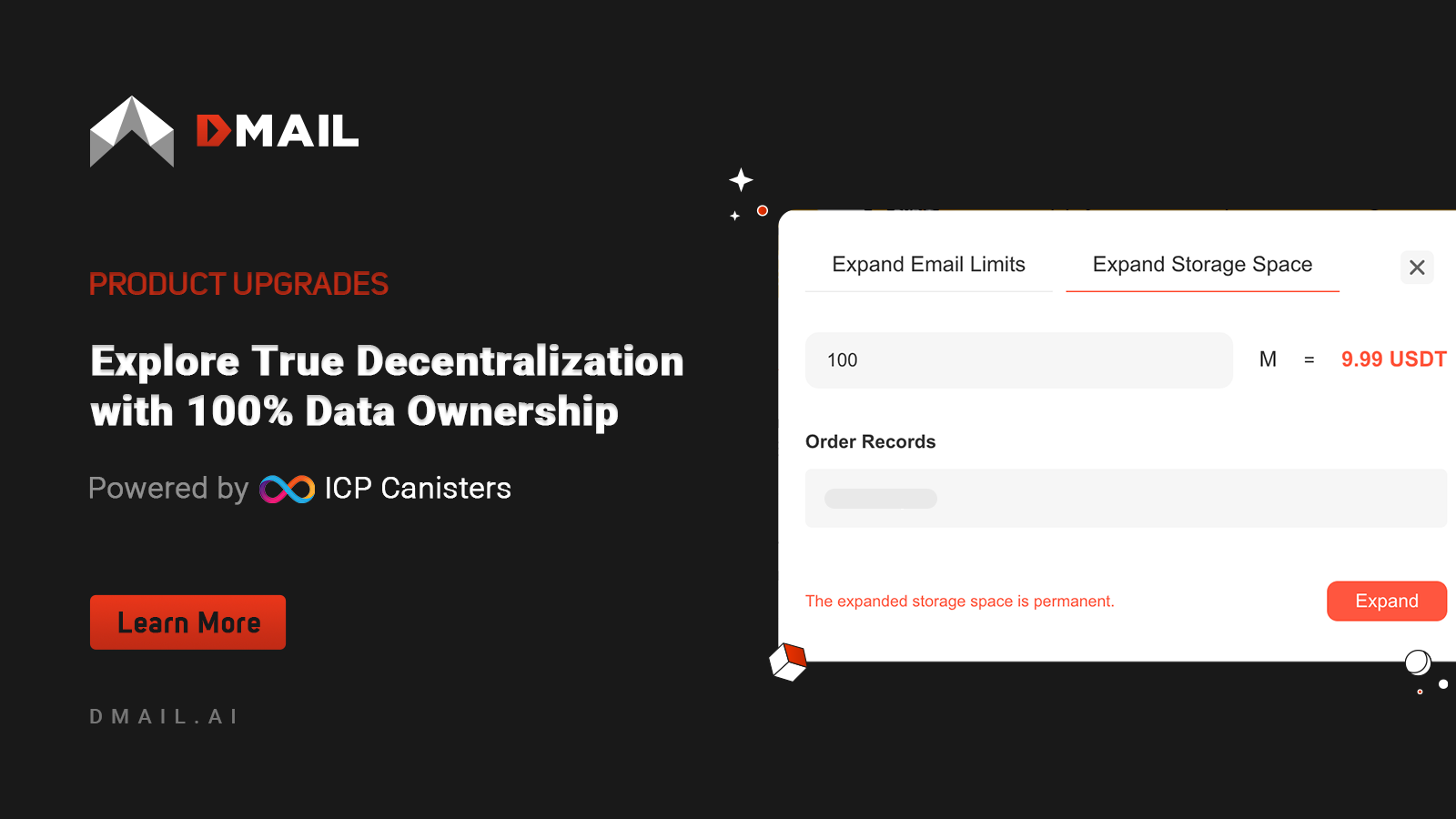
Privacy isn’t a feature. It’s infrastructure.
In Web2, every message, file, and attachment lives on someone else’s servers — scanned, indexed, and monetized.
Dmail ends that cycle completely.
Powered by Storacha and other decentralized storage integrations, Dmail’s Drive system secures your data across a distributed network.
No central authority. No single point of failure. No one watching.
Where Your Data Actually Lives
When you send a message or upload a file inside Dmail, it doesn’t sit on a private server in Silicon Valley.
Instead, it’s encrypted client-side and distributed across decentralized storage nodes running the Storacha protocol.
Each file or message fragment is:
- Encrypted using AES or asymmetric key pairs.
- Sharded into smaller pieces for redundancy.
- Stored across multiple independent nodes for resilience.
Only your wallet can reassemble and decrypt the data — even Dmail can’t access it.
That’s what real data ownership looks like.
The Storacha Partnership: Efficiency Meets Encryption
Storacha is Dmail’s key partner in ensuring high-speed, verifiable decentralized storage without sacrificing performance.
Traditional blockchain storage can be slow and expensive. Storacha solves that with a hybrid layer — distributed node storage with off-chain indexing and proof-of-storage verification.
For Dmail users, that means:
- Instant file retrieval with near-zero downtime.
- Verifiable proof-of-data integrity on-chain.
- Cost-efficient storage compared to pure on-chain solutions.
It’s the technical bridge between decentralization and real-world usability.
Beyond Attachments: A Full Decentralized Drive
The Dmail Drive isn’t limited to message attachments. It functions as a complete personal cloud, fully integrated with your Dmail identity.
You can:
- Upload, organize, and share files securely with wallet-based permissions.
- Attach documents directly into encrypted Dmail messages.
- Collaborate with team members using token-based access control.
- Manage storage across multiple chains and networks through one interface.
Think of it as Google Drive rebuilt for the decentralized era — private by design, composable by nature.
Why It Matters for the Future of Work
Every enterprise depends on secure document exchange.
In Web3, that means moving beyond “trusting” cloud providers to verifying ownership at every layer.
Dmail’s decentralized Drive transforms file storage into a zero-trust system:
- No admins, no leaks, no backdoors.
- Every access request is signed and verifiable.
- Data can be mirrored across partner nodes globally for performance and redundancy.
This isn’t file storage. It’s data autonomy — the ability to own, move, and protect your information anywhere in the digital economy.
The Infrastructure Behind the Inbox
Dmail’s Drive and Storacha integration redefine what a communication network can be.
It’s not just about sending messages — it’s about building a private internet backbone, where every byte you produce belongs to you and no one else.
When you store data on Dmail, you’re not uploading files.
You’re deploying assets into your own encrypted micro-cloud — permissionless, portable, permanent.

Connect with Dmail: Website | Twitter | Discord | Github | Telegram
Comments ()